Pages

Friday, May 27, 2011

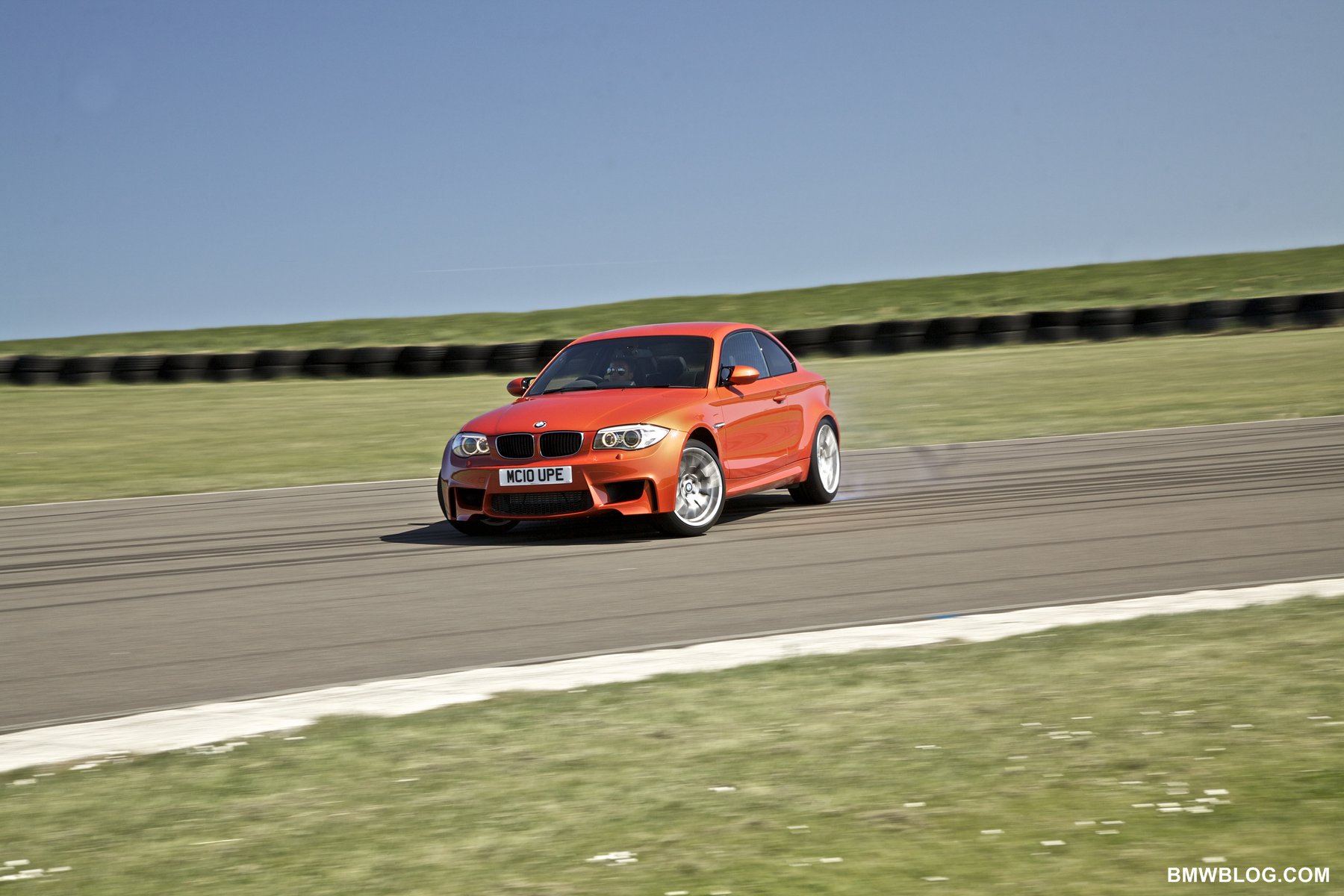
Photo Gallery: BMW 1M in the UK

A new photo BMW 1M gallery emerges from the UK press drives. For the respective market, BMW will offer 450 units of the 1M, each one of them carrying a plate to emphasize the “limited edition” of the baby-M. The US customers will receive anywhere from 600 to 1,000 units by the end of this year, and recent reports confirm that the production will end in 2011.
For those of you that missed our comprehensive test drive of the 1M, here are some of our thoughts from the track:
“The 1M on the track is addictive. It’s a combination of great sounds, great chassis, and a thoroughly well matched powerplant to the car. It’s shorter wheelbasemakes it just that much more nimble than larger cars and all of that torque, available almost off idle this will make the 1M a killer on any track with a surfeit of slow speed corners. This thing is nasty quick, it just digs hard out of the corners. Go wide open throttle and you’ll get the additional torque from the overboost function for about five seconds, enough to propel you headlong into the next corner.
The latest photo gallery showcases once again the Valencia Orange metallic paint with the 1M being driven both on and off the track.

LCD gauges coming for refreshed BMW 5 and 7 Series models

Autoblog reports on a new technology that will be fitted in the facelifted 5 and 7 Series models. BMW is getting ready to offer a fully configurable LCD gauge cluster, similar to what Mercedes introduced in the S-Class or Jaguar in their XJ flagship.
According to the publication, the development takes place as a mixed effort between the BMW Technology Office in Palo Alto, CA and the Munich development team. The new gauge cluster will display the standard dials for speed, revs, fuel and temp, but can be configured to show additional navigation, telematics and infotainment data depending on the driving mode.
Essentially, more driver-centric information will be displayed as needed or configured, another step towards the ConnectedDrive technology featured in the recently unveiled Vision Concept.
A BMW engineer said for Autoblog that BMW doesn’t want to rely on digital representations of analog gauges, but rather use a black canvas that can display information in a variety of ways. The customization process will be kept to a minimum though, a move that will allow the company to focus on usability.
The BMW 7 Series is due for a refresh in 2013, followed a year later by the F10 5 Series.

Would You Buy A Z4 Coupe?

The start of the 1990′s brought BMW’s biggest step forward in it’s big two door via the 8 Series. At its release in 1991, the 850i was the most expensive and most technically advanced vehicle in the history of the black, blue and white badge. In European spec, the 8 Series even came with an early version of the modern ASR system found on the F01 7 Series – allowing the driver to provide a few degrees of steering input to the rear wheels for improved handling at speed. Additionally, the variety of engines helped the 8 Series reach wider appeal with the M62 V8 engine of the 840i and the M70 V12 of the 850i.
With the demise of the ultra BMW coupe in the late 1990′s – many would think that it would not be until 2004 when the next 6 Series was released before BMW had another true coupe in the line-up.  However, that would be an incorrect statement. During BMW’s absence from the big coupe market the role was supplanted by the tiny but quite wide E36 M Coupe based upon original Z3 Coupe. With a petite, lithe figure from head-on – the car swelled to a gigantic rear with blistered wheel arches and a fat, quad exhaust. Perhaps the Kim Kardashian of the late 90′s car market?
Due to it’s proportions and roofline , the Z3-based M Coupe was nicknamed the “Clown Shoe” and unlike a Kardashian, the original M Coupe had gobs of talent with its European-spec S50B32 engine pumping out 321 German horsies. In 2001, with the introduction of the E46 M3, the little 3 door coupe reached full potential with the S54B32 tucked under the hood for 333HP on tap. To manage the power, a limited slip differential was added over the standard Z3 coupe. All in, the Z3 M Coupe was one of the most underrated German sports cars of the late 1990′s and early 2000′s and ironically, a car manufactured by engineers in their off-time with the intent of improving the torsional rigidity and overall performance of the original Z3 Convertible. By keeping the production and retooling costs to a minimum, the M Coupe was able to be brought to market – hence the sharing of many parts from the Z3 Convertible.
The original Z3 and M Coupe did not find a substantial market as this sort of shooting brake design was a far cry from what many expected from a BMW. However, as production wound down in 2002 – the car would quickly reach near-legend status with enthusiasts and the fastest S54-powered Coupes began fetching higher prices in the user car market.
Given the success of the original Z3 convertible, the Z4 replaced it in 2003 though the fate of the coupe version was yet to be determined. By 2005, a concept previewing the Z4 Coupe was released – giving enthusiasts hope for a new, lightweight baby BMW performance car. What followed did not disappoint – the Z4-based M Coupe took on the same S54 powerplant but adopted a much more elegant and sleek body, forgoing the enormous rump in favor of a more supple, tapered tail. The standard 3.0Si Coupe was a looker too and definitely no slouch with its 3.0L N52 engine with Valvetronic and 258 HP. However, as the global economy began to slow, the Z4 Coupe and M Coupe began to experience sales declines with incentives and “cash-in-trunk” deals being offered on the car just prior to the end of production. Despite the slowdown in sales, the performance and design of the second BMW shooting brake cannot be downplayed as one of the most fun and sexy BMW’s on sale in the last decade.
That said, will the Germans see it fit to grace the world with another small BMW coupe? We have the big 6 again in the F13 6 Series – but nothing to satisfy the lighter, smaller class of cars where performance isn’t entirely compromised by luxury. Yes, the 1 M Coupe satisfies that spot to a degree – but it does not have the sex appeal of a long-nosed sports car with a short wheel base and two kidney grills at the front. Frankly, the idea of either a coupe version of the Z4 sdrive35is or even an M-powered coupe pounding around with a S65 V8 under the hood – not too far off from a roadgoing Z4 GT3 perhaps?
The current Z4 sDrive35is has had its share of problems on the market given the type of incentives BMW is offering. Had BMW forgone the current Z4is and put an M-derived Z4 in its place – would sales perhaps be higher by better catering to the enthusiast market?
Included here are a few renderings from a post we had back in the fall hypothesizing what a Z4 Coupecould look like. It’s gorgeous and that’s not surprising – the current E89 Z4 Convertible is a gorgeous car too. Its wonderful with the long, sloping nose gliding back to the subtle yet still pronounced hips. If the E89 is such a big improvement and less polarizing over the E85 in droptop form – then how could an E89 coupe possibly be wrong?
Coupes have always had an important role in the history of BMW over the last 8 decades. It started with the 328 Karmann Coupe in pre-World War II Europe. The big coupe won the 1940 Mille Miglia and with its success would fall under the curtain of war spreading across Germany and the rest of Europe.
About 3 decades on an the world would be lucky enough to meet the BMW E9 coupe – which would go on to be a huge success in the European touring car series’, the 12 Hours of Sebring, and solidify BMW’s position as a genuine maker of modern, high performance coupes. The success of the roadgoing 3.0CSi of the early 1970′s was followed up by the more expensive, more luxurious and higher performing original E24 6 Series which would receive only minor cosmetic changes and a handful of engine upgrades over its 13 year production life culminating in the ultimate iteration with the first M6 in the history of BMW – powered by the venerable straight-six M88 engine.
The start of the 1990′s brought BMW’s biggest step forward in it’s big two door via the 8 Series. At its release in 1991, the 850i was the most expensive and most technically advanced vehicle in the history of the black, blue and white badge. In European spec, the 8 Series even came with an early version of the modern ASR system found on the F01 7 Series – allowing the driver to provide a few degrees of steering input to the rear wheels for improved handling at speed. Additionally, the variety of engines helped the 8 Series reach wider appeal with the M62 V8 engine of the 840i and the M70 V12 of the 850i.

Preview: Next generation 2014 BMW X5 and 2015 X6

Design wise, the interior goes through an extensive revamp. The magazine says the cabin layout will resemble the one found in the 5 Series GT, with a focus on luxury and driver orientation.
According to our own sources, the new 2013 BMW X5 is said to feature more flowing character lines and sculpted surfaces that will broaden the design of the X family. At the front end, the new X5 will feature a more imposing kidney grille, larger and wider than in the current model. The headlights will get the LED treatment and the shape will follow the design seen on some of the recently unveiled models.
The taillights will be slightly redesigned as well. Using the layering concept seen on the Vision concepts, the T-shaped taillights add more depth to surfaces and are less wrapped around the body.
On the side, the character line is being enhanced, as we have seen on the new X3 as well. Expect to see more convex/concave shapes with 3D layering enhancing its masculine look. It is unknown at the moment if the dimensions of the new X5 will be increased, the current X5 can already accommodate 7 passengers if needed.
For the 2014 X6, BMW will work to improve the practicality of the Sports Activity Coupe. A redesigned stern improves visibility and creates quantifiably more rear headroom. Wider rear doors ease entry and exit. The new X6 also gets a more dynamic looking greenhouse.
To make use of the new four-cylinder turbocharged engines, the entry-level X5 and X6s will be equipped with 2.0 liter diesels developing 245 hp and 260 lb-ft, and a 2.0 liter gasoline unit – 245bhp and 260 lb-ft.
Perhaps the most exciting engine BMW has up its sleeve, though, will be the twin-turbo diesel shoehorned into the X5/X6 50d. The high-performance oil-burning straight-six develops 405 hp, but it may not reach the U.S. shore. Hybrids are still in play and the new variants will feature a 110 hp electric motor housed into a ZF nine-speed automatic, and will initially be paired with a 350-hp inline-six.
With almost three years before the public debut,Automobile Magazine brings to light new information on the next generation BMW X5 and X6 SAVs. According to the popular magazine, both models are based on a new components set known in-house as “X for all.”
For the X5 and X6, “X for all” means new axles derived from the F10 5 Series sedan. According to BMW, these will reduce the weight by up to 330-pounds. As a result, the lightest X5 replacement is said to undercut the two-ton mark by a small yet significant margin.
In the new design, BMW intends to offer the optional active steering, a self-leveling air suspension and Adaptive Drive, which employs adjustable anti-roll bars. As with all the new BMW models, the future F15 X5and F16 X6 will incorporate technologies like lane departure warning, night vision, park assist, active cruise control and traffic sign recognition.

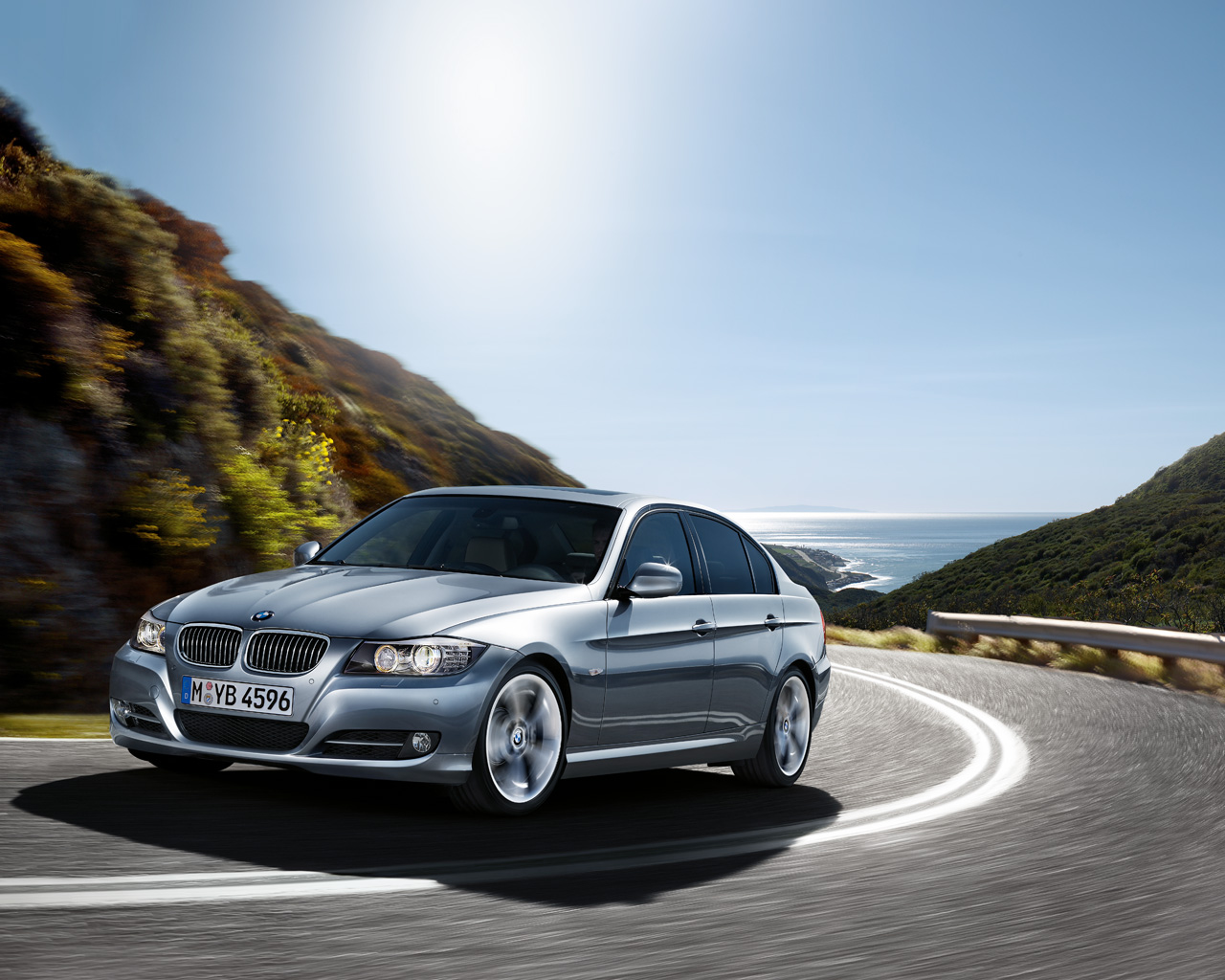
BMW 3 Series Sedan Production end in October 2011

BMW is getting back to basics with clean uncluttered shapes, plus lower and wider kidney grille openings. The sedan model has a longer wheelbase, at least 1.5″ longer than the current generation. The F30 will sport a “pushing nose”, somewhat similar to the E89 Z4 front-end.
BMW will live under the umbrella of EfficientDynamics, and technologies like aerodynamically designed wheels, solar roof panel for extra energy efficiency in the use of interior controls, brake energy regeneration , stop-start technology, and pre-heating technology for the engine, gearbox and differential, will be incorporated into the new model.
Next generation 3-series engine options will include a full range of turbo and naturally aspirated 6-cylinder motors, 4-cylinder motors, and possibly even a new 3-cylinder motor.
The all-star BMW M3 will continue to sport the aggressive and super sporty bodystyle we have seen in the past. The new M3 will also feature a twin-turbo six-cylinder engine producing somewhere around 450 horsepower.
BMW announced today that production for the BMW 3Series Sedan ends in October 2011. The only 3er diesel available in the U.S., the 335d, will also production in August.
BMW is preparing for the launch of the new F30 3 Series Sedan which goes on sale in Spring 2012. The new 3 Series is built on a new modular platform and design wise, it returns to the “slimmer look”, dynamic lines with squat proportions and short rear overhangs.
The typical proportions of a 3 Series remain, but the exterior design is more toned and muscular, bringing some the aggressiveness and design lines seen in the recent models, including the F10 5 Series. An expected move seen across the new BMW design language.
 
a a